
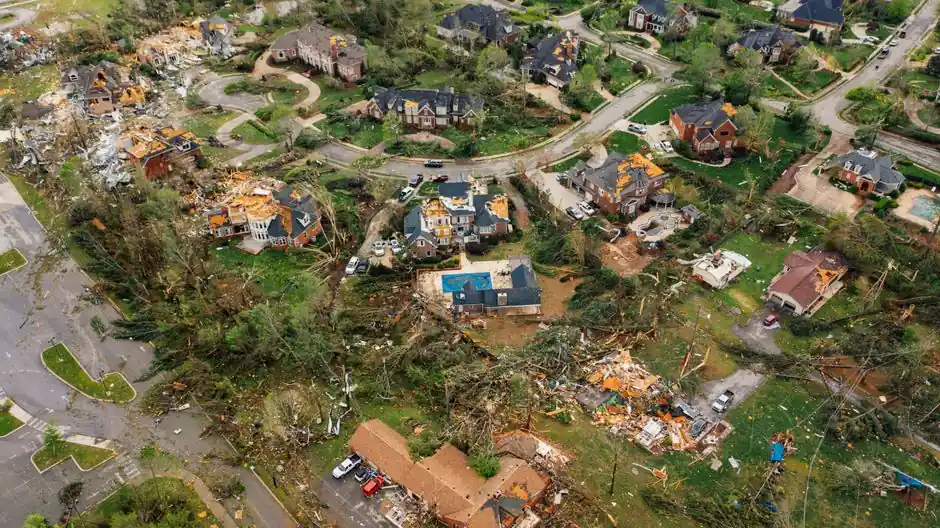
When a tree hits your roof in Annapolis, get everyone out of the house, call 911 if anyone is hurt or a power line is down, and then call a 24/7 emergency roofer before you touch anything. Emergency roof repair Annapolis tree damage is a stabilization job first - you are stopping water from getting in, not rebuilding the roof. The storm itself lasts minutes; the water damage that follows lasts months if nobody tarps the opening.
We run these calls all over Anne Arundel County, and the pattern is always the same: the homeowner is standing in the yard in the rain, the tree is still on the roof, and water is already finding its way into the attic. Below is exactly what to do in the first half hour, what emergency roof repair costs in Annapolis in 2026, how Maryland insurance handles tree damage, and when it is time to stop DIY-ing and hand it to a crew.
What to do in the first 30 minutes after a tree hits your roof
The first 30 minutes after a tree hits your roof are about safety and containment, not repair. Do these in order, and do not skip step one because the damage looks minor from the ground.
- Get everyone out and away from the structure. A limb that punched through the decking can shift the load on rafters. If you hear creaking, popping, or see a sag in the ceiling, leave and stay out.
- Call 911 if a power line is involved. Downed lines near a wet roof are the single most dangerous part of the whole event. BGE and the fire department handle that, not a roofer.
- Call an emergency roofer in Annapolis. You want a crew that can tarp the breach the same day. Water intrusion in the first 24 hours causes more interior damage than the impact itself.
- Photograph everything before you move a branch. Wide shots of the house, close shots of the impact point, and shots of any interior water staining. Your adjuster will want all of it.
- Kill the power to affected rooms at the breaker panel if water is dripping near fixtures or outlets.
- Put buckets down and pull electronics off the floor. Move furniture, rugs, and anything valuable out of the drip zone.
What you should not do: climb the roof, cut the tree yourself, or walk under a limb that is still supported by the roof. A hanging branch under tension can snap back and kill someone. Leave the tree work to a licensed arborist and the roof work to us.
If the tree only clipped the edge of the roof and you have a slow drip, you still want a pro out within a day or two. Small punctures in asphalt shingles let in far more water than homeowners expect. Our team handles Roof Repair in Maryland for exactly this kind of damage, from a single punctured shingle field to a full section of crushed decking.
How much does emergency roof repair cost in Annapolis?
Emergency roof repair in Annapolis runs $450 to $1,200 for tarping and temporary stabilization, and $1,500 to $8,000 or more for structural repair once the tree is removed. Typical 2026 pricing in this area breaks down like this:
- Emergency tarping: $450-$1,200, depending on roof pitch, size of the breach, and how much tree has to be cleared first.
- Shingle and decking repair (small impact, one rafter bay): $900-$2,500.
- Structural repair (cracked rafters, ridge damage, multiple bays): $2,500-$8,000.
- Tree removal (separate arborist bill): $500-$2,500 for a mid-size tree on a roof.
- Interior water damage (drywall, insulation, paint): $800-$4,000, often handled by a restoration company.
Two things drive the number more than anything else: how steep the roof is and how much of the tree is still sitting on it. A low-slope garage roof with one limb is a fast, cheap tarp. A steep two-story colonial with a 40-foot oak through the ridge is a different job entirely.
We give you the tarp price before we start, and we tell you what the permanent repair will run once we can see the decking. No surprise line items after the fact.
Does insurance cover tree damage to a roof in Maryland?
Yes - in almost every case, a standard Maryland homeowners policy covers tree damage to the roof, including the cost of removing the tree from the structure, up to your policy limits. The tree falling on your house is a covered peril. What is not covered is the tree removal itself if the tree never touched a covered structure.
A few things Maryland homeowners get wrong about this:
- Neglect is the exception. If a dead tree was visibly rotting and leaning over the roof for two years, the adjuster may argue you failed to maintain the property. Documented tree care helps here.
- Tree removal caps are real. Many policies cap debris removal at $500-$1,000. Read that section before you assume the whole arborist bill is covered.
- Your deductible still applies. If your deductible is $2,500 and the repair is $3,000, you are paying most of it out of pocket.
- You need a contractor's documentation. Adjusters work off photos, measurements, and a written scope. We provide that as part of the job.
File the claim the same day you call us. Do not wait for the tree to be removed first - the clock on water damage and mold starts immediately, and most carriers want notice within a reasonable window.
If the storm that dropped the tree also took shingles off the rest of the roof, that is a separate claim line and usually a bigger one. We handle Storm Damage Roof Repair in Maryland for hail, wind, and fallen-tree events across the county, and we document the whole roof, not just the impact point.
Why Annapolis roofs take tree damage harder than most of Maryland
Annapolis roofs take tree damage harder than most of Maryland because of the combination of mature tree canopy, waterfront wind exposure, and housing stock that is often 40 to 100 years old. The city sits between the Severn River and the Chesapeake Bay, and the tree cover in neighborhoods like Eastport, Murray Hill, and the streets off Spa Creek is dense and old.
Three local factors matter:
Soil saturation. Annapolis gets roughly 45 inches of rain a year, and the clay-heavy soil near the water holds it. A saturated root plate gives way in wind far sooner than a dry one. That is why so many tree-on-roof calls come after two or three days of steady rain, not during the peak gust.
Wind off the water. Hurricanes and tropical remnants that come up the Bay hit waterfront properties with nothing to break the wind. A nor'easter in October or November can drop a limb on a roof in Arnold or Cape St. Claire just as easily as a named storm.
Older roof structures. Plenty of homes in the historic district still have original rafters and skip sheathing. That framing is strong, but it is brittle, and a 2,000-pound limb does not care how well it was built.
We work these neighborhoods constantly, and the crews know which streets have narrow access, which ones need a crane, and which ones you can tarp from a ladder. If you are nearby and want a local crew, our Roofing in Annapolis page covers the areas we serve and how fast we can get out.
What our emergency roof tarping process looks like
Our emergency roof tarping process is a four-step stabilization: assess from the ground, clear what is safe to clear, secure the breach with weighted tarp, and photograph the whole thing for your claim. We are not trying to fix the roof at 11 p.m. in a rainstorm. We are trying to stop the water.
Here is what actually happens when we roll up:
- Ground assessment. We look at the impact point, the tree's position, and whether the structure is safe to work on. If the tree is still loaded on the roof, we coordinate with an arborist before anyone goes up.
- Interior check. We go inside with a moisture meter and a flashlight to find where water is already tracking. Attic staining tells us where the breach actually is, which is not always where the tree hit.
- Tarp and secure. Heavy-duty 6-mil or 10-mil tarp, screwed down with battens, not just laid over the ridge. A tarp that flaps loose in the next storm is worse than no tarp.
- Document and schedule. Photos, measurements, and a written scope for the permanent repair. We schedule the rebuild once the tree is off and the weather clears.
If you need this tonight, we run Emergency Roofing Services in Maryland around the clock. Call, tell us what hit the roof, and we will tell you on the phone whether it can wait until morning or needs a tarp now.
Common mistakes homeowners make after a tree hits the roof
The most expensive mistake homeowners make after a tree hits the roof is waiting to see if it leaks. Water finds the path of least resistance within hours, and by the time you see a brown ring on the ceiling, the insulation and drywall above it are already soaked.
Other ones we see every storm season:
- Climbing up to inspect it yourself. Wet shingles, a loaded limb, and a ladder are a bad combination. People get hurt doing this every year.
- Cutting the tree off the roof without bracing. When you cut a limb that is holding load off a cracked rafter, the roof can drop. Arborist first, roofer second, in that order.
- Tarps nailed down wrong. Nailing through the tarp into good shingles creates new leaks. Weights and battens, or screws into the sheathing at the edges, not through the field.
- Filing the claim late. Maryland carriers expect prompt notice. A two-week delay gives them room to question whether the damage was storm-related.
- Accepting the first repair bid without a moisture check. A roofer who never goes in the attic is guessing at the scope.
One more: do not throw away the tree. Your adjuster may want to see the species and condition. A healthy oak that came down in a 60-mph gust is a covered event. A dead pine that had been leaning for years is a fight.
When to call a professional
Call a professional the moment a tree touches your roof, even if nothing is dripping yet. There is no version of this where waiting helps. A puncture you cannot see from the ground can soak a ceiling overnight.
Call us immediately if any of these are true:
- The tree is still on the roof or leaning against the house.
- You can see daylight through the attic decking.
- Water is staining ceilings, running down walls, or pooling on the floor.
- You hear creaking, popping, or the ceiling looks bowed.
- Shingles are missing across a wide area, not just at the impact point.
RoofPros Maryland handles emergency roof repair across Annapolis and Anne Arundel County. We tarp, we document, we work with your adjuster, and we do the permanent repair when the weather clears. If you want a crew that knows these neighborhoods and these roofs, that is what we do. You can see the full range of what we handle on our Roofing in Maryland page, or just pick up the phone and describe what hit the house.
Frequently Asked Questions
What should I do when a tree hits my roof in Annapolis?
Get everyone out, call 911 if a power line is down, then call a 24/7 emergency roofer to tarp the breach - ideally within 24 hours. Photograph the damage before moving anything, kill power to wet rooms, and do not climb the roof yourself. Stabilization first, permanent repair after the tree is removed.
How much does emergency roof repair cost in Annapolis?
Emergency tarping in Annapolis runs $450 to $1,200 in 2026. Permanent structural repair after tree removal runs $1,500 to $8,000 depending on how many rafter bays and how much decking was damaged. Tree removal is a separate arborist bill, usually $500 to $2,500.
Does insurance cover tree damage to roof in Maryland?
Yes, standard Maryland homeowners policies cover tree damage to the roof and typically include some debris removal, often capped at $500 to $1,000. Your deductible still applies, and a visibly dead or neglected tree can complicate the claim. File the same day the damage happens.
Who offers 24/7 emergency roof repair in Annapolis?
RoofPros Maryland runs 24/7 emergency roof repair in Annapolis and across Anne Arundel County. We tarp same-day, document the damage for your insurance claim, and schedule the permanent repair once the tree is off the roof. Call and describe the impact - we will tell you if it can wait until morning.
How long can I wait before tarping a roof after tree damage?
Do not wait more than 24 hours. Water intrusion starts within hours of the breach, and mold can begin colonizing wet insulation and drywall in 24 to 48 hours. Even a slow drip from a small puncture can soak a ceiling cavity in a single overnight rain.
Get help with Roofing in Annapolis
A tree on the roof is a same-day problem, and we treat it like one. Call RoofPros Maryland at (833) 409-1163 and we will get a crew out to tarp the breach, document the damage, and start the repair.